

Retaining walls solve three fundamental landscape problems in Michigan: controlling erosion on sloped lots, creating usable flat space on grade changes, and managing water drainage in clay-heavy soils. This guide covers the wall types, costs, permit requirements, and Michigan-specific engineering factors that determine whether your retaining wall stands for 30 years or fails in 5.
When You Need a Retaining Wall
A retaining wall is required whenever soil needs to be held at two different elevations. In Oakland County, the most common situations include:
- Grade changes of 18 inches or more: Any slope steeper than a 3:1 ratio (3 feet horizontal for every 1 foot vertical) risks erosion and soil migration without structural retention.
- Erosion control: Michigan's spring snowmelt and heavy rainfall events (Oakland County averages 33 inches of precipitation annually) wash unretained soil downhill, undermining bases, driveways, and landscape features.
- Creating usable space: A sloped backyard becomes a level patio, fire pit area, or garden bed when a retaining wall terraces the grade into flat sections.
- Base protection: Walls redirect water and soil pressure away from home bases, preventing basement moisture problems that plague many Oakland County homes built on clay soils.
Retaining Wall Types: A Complete Comparison
Five retaining wall types are commonly installed in Michigan. Each has distinct advantages, limitations, and cost profiles. The right choice depends on wall height, aesthetic goals, site conditions, and budget.
| Wall Type | Best Height | Pros | Cons | Cost (Installed) |
|---|---|---|---|---|
| Natural Boulder | 2-6 ft | Natural look, extremely durable, no mortar joints to fail | Requires heavy equipment, imprecise aesthetics | $25 - $50/sqft |
| Segmental Block (SRW) | 2-6 ft | Uniform appearance, engineered for drainage, DIY-possible for low walls | Can look generic, limited color options | $30 - $55/sqft |
| Techo-Bloc Wall Systems | 2-8 ft | Premium aesthetics, freeze-thaw rated, extended warranty | Higher material cost, requires certified installer | $40 - $75/sqft |
| Natural Stone (Cut) | 2-5 ft | Elegant appearance, unique character, high property value impact | Most expensive, longer installation time, limited availability | $45 - $75/sqft |
| Poured Concrete | 4-12+ ft | Maximum structural strength, any height, engineer-designed | Industrial appearance (unless veneered), most expensive for tall walls | $35 - $65/sqft |
Boulder Retaining Walls
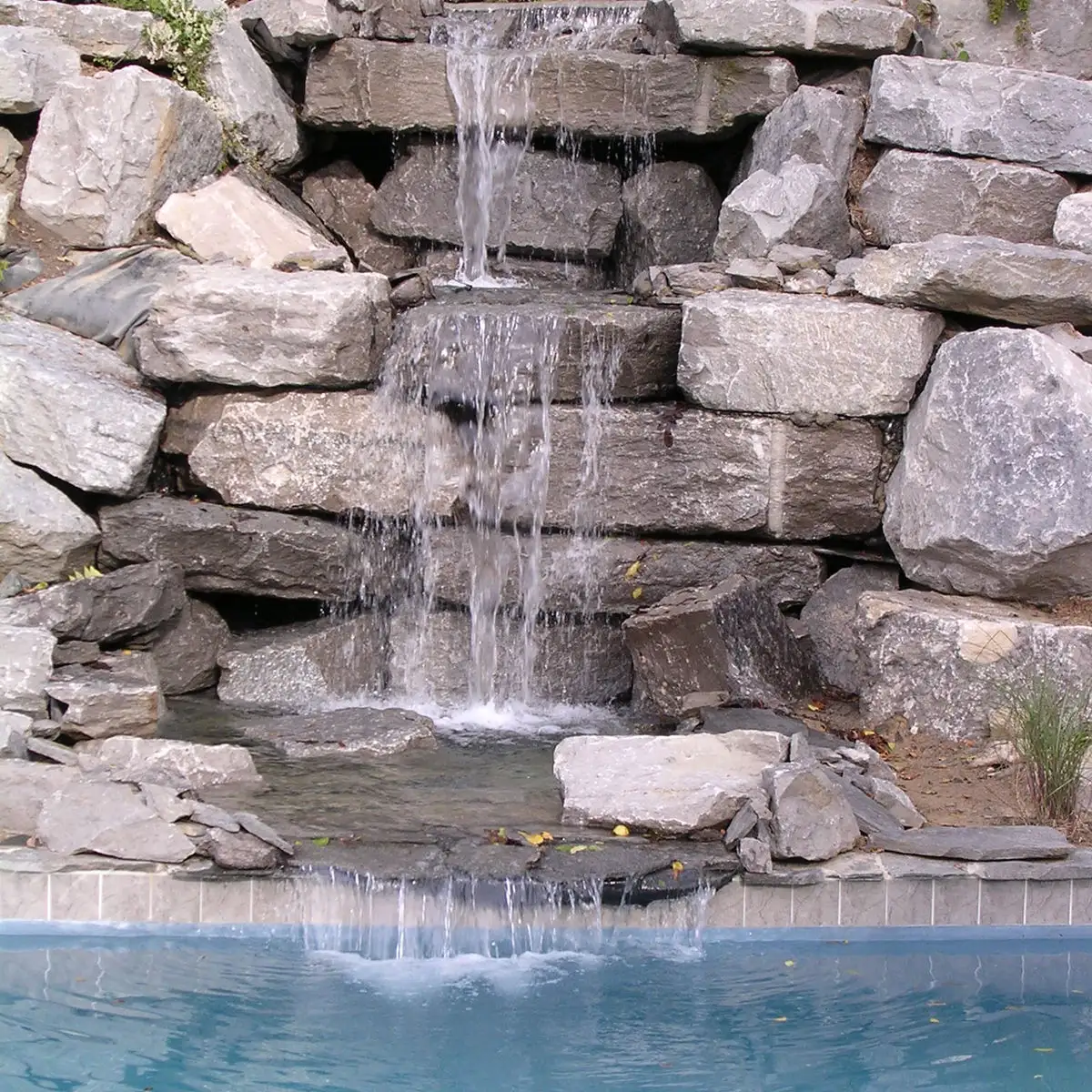
Boulder walls are the most popular retaining wall type in Michigan for walls under 4 feet. Michigan fieldstone and Onaway limestone are sourced locally, reducing transportation costs. The boulders' mass provides inherent stability, and the natural appearance integrates well with Michigan landscapes. Earth Art has installed boulder retaining walls across Oakland County for nearly four decades, and many of our earliest installations from the late 1980s remain structurally sound today.
Boulder walls work best on properties where a natural, informal aesthetic is desired. They are less suitable for formal landscapes or situations requiring precise, uniform wall faces.
Segmental Retaining Walls (SRW)
Segmental block walls use engineered concrete units that interlock mechanically, creating structural integrity without mortar. These are manufactured to consistent dimensions, producing clean, uniform wall faces. Leading manufacturers include Allan Block, Versa-Lok, and Belgard. For walls over 4 feet, segmental systems use geogrid reinforcement layers that tie back into the retained soil, dramatically increasing structural capacity.
Techo-Bloc Wall Systems
Techo-Bloc offers several retaining wall product lines that combine the engineering of segmental systems with significantly higher aesthetic quality. Their Mini-Creta and Graphix Wall products feature realistic stone textures and color blends that standard block walls cannot match. As a Techo-Pro certified installer, Earth Art has access to Techo-Bloc's full wall product catalog and extended warranty program.
Michigan-Specific Soil and Frost Considerations
Michigan's 42-inch frost line is the deepest in the Great Lakes region and creates engineering demands that retaining wall builders in warmer climates never face. Every retaining wall footing in Michigan must extend below the frost line, or the wall will heave during winter and lose structural integrity.
Clay Soils and Hydrostatic Pressure
Oakland County sits predominantly on Blount-Pewamo clay loam and Morley-Blount silty clay loam, according to the USDA Soil Survey. Clay soils present two critical challenges for retaining walls:
- Poor drainage: Clay absorbs and retains water, creating hydrostatic pressure behind walls. A saturated clay soil can exert 60 to 80 pounds per cubic foot of lateral pressure, more than double the pressure of well-drained granular soils. Without adequate drainage, this pressure will push walls forward and cause structural failure.
- Frost expansion: Wet clay expands 9% by volume when frozen. Behind a retaining wall, this expansion creates massive horizontal forces. A 4-foot wall retaining saturated clay can experience frost pressures exceeding 2,000 pounds per linear foot.
Drainage Behind Walls Is Non-Negotiable
Every retaining wall in Michigan must include a drainage system behind the wall face. The standard approach includes a 12-inch zone of clean crushed stone (no fines) directly behind the wall, a 4-inch perforated drain pipe at the base wrapped in filter fabric, and drainage swales or outlets that carry collected water away from the wall and base. Skipping drainage is the number one cause of retaining wall failure in Southeast Michigan. We encounter failed walls regularly on projects where the original builder omitted the drain system to save on materials and labor.
Permits and Engineering Requirements
Michigan building code and most Oakland County township ordinances require permits for retaining walls over 4 feet in exposed height (measured from the base of the footing to the top of the wall). Some townships, including Bloomfield Township and Troy, have additional requirements.
- Walls under 4 feet: Generally no permit required, but must still meet setback requirements (typically 3 to 5 feet from property lines).
- Walls 4 feet and over: Require a building permit and stamped engineering drawings from a licensed Professional Engineer (PE). The engineering analysis ensures the wall design accounts for soil type, water table, surcharge loads (driveways, structures above the wall), and seismic factors.
- Walls near utilities: MISS DIG (Michigan's one-call system, 811) must be contacted before any excavation. Oakland County has dense underground utility infrastructure, and striking a gas line, water main, or fiber optic cable creates liability and project delays.
Engineering fees for retaining walls in Oakland County typically range from $1,500 to $3,500 depending on wall complexity and site conditions. This cost is separate from the wall installation and is required before a building permit will be issued.
Retaining Wall Costs in Oakland County
Installed costs for retaining walls in Oakland County range from $25 to $75 per square foot of wall face, depending on the wall type, height, site access, and soil conditions. Here is how costs break down for a typical 40-linear-foot wall.
- 3-foot boulder wall (120 sqft face): $3,000 to $6,000
- 3-foot segmental block wall (120 sqft face): $3,600 to $6,600
- 4-foot Techo-Bloc wall (160 sqft face): $6,400 to $12,000
- 6-foot engineered wall (240 sqft face): $12,000 to $18,000+ (includes engineering)
Costs increase significantly for walls that require difficult site access (rear yards without equipment paths), removal of existing failed walls, or extensive regrading. Terraced wall systems (multiple shorter walls stepping up a slope) cost more per linear foot than a single tall wall but distribute forces more effectively and often eliminate the need for engineering.
How Long Should a Retaining Wall Last in Michigan?
A properly built retaining wall in Michigan should last a minimum of 25 to 30 years with zero maintenance. Boulder walls can last 50 years or longer because they have no mortar joints, adhesives, or mechanical connections that degrade over time. Segmental block and Techo-Bloc walls with geogrid reinforcement should perform for 30 to 50 years. Poured concrete walls have the longest theoretical lifespan at 50 to 75 years, though surface spalling from freeze-thaw exposure is common after 20 to 30 years.
The key variable is not the wall material. It is the drainage system and base preparation. A premium wall material on a poor base with no drainage will fail faster than a basic wall material on a proper base with excellent drainage.
Get a Free Retaining Wall Estimate
Earth Art Landscaping has been building retaining walls across Oakland County since 1987. We assess your site, recommend the right wall type for your specific soil conditions and grade change, and provide a detailed estimate before any work begins. Call 810-343-4799 or request a free quote online to schedule your consultation.