

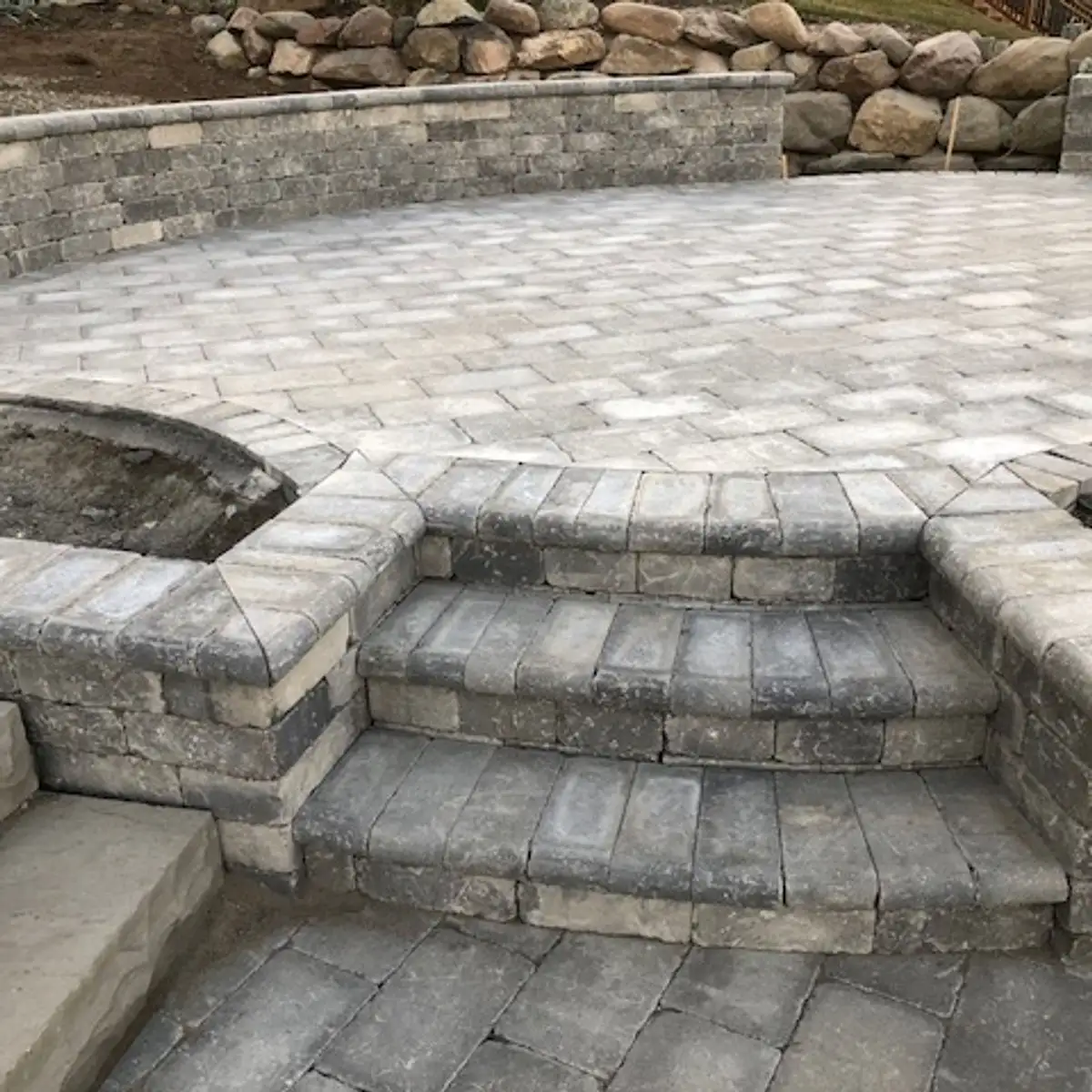
A paver walkway is one of the highest-return hardscaping investments you can make in Oakland County. It replaces cracked concrete or worn-out stepping stones with a durable, finished surface that improves curb appeal, directs foot traffic away from your lawn, and connects your home to outdoor living areas like patios and gardens. Unlike poured concrete, individual pavers flex with Michigan's freeze-thaw cycles instead of cracking, and damaged sections can be repaired without tearing out the entire path. This guide covers everything you need to plan a walkway project that looks intentional, performs for decades, and fits the character of your property.
Why Paver Walkways Outperform Concrete in Michigan
Oakland County sees 40 to 60 freeze-thaw cycles every winter. Water seeps into the ground, freezes, expands, and pushes the surface upward. When it thaws, the surface settles back — but never quite evenly. Poured concrete handles this by cracking. Once a crack forms, water enters, freezes inside the crack, and the damage accelerates each winter until the slab needs full replacement.
Paver walkways are engineered differently. Each paver is an independent unit set on a compacted aggregate base with polymeric sand joints. When the ground shifts during freeze-thaw, the individual pavers move independently and resettle as the ground stabilizes in spring. The joints absorb the movement that would crack a concrete slab. After 39 years of installing walkways across Troy, Rochester Hills, Bloomfield Township, and communities throughout Oakland County, we consistently see properly installed paver walkways outlast concrete by 15 to 25 years with minimal maintenance.
Material Options for Oakland County Walkways
Techo-Bloc Pavers
As a Techo-Pro certified installer since 2018, we recommend Techo-Bloc pavers for most walkway projects. Their products are manufactured with a minimum compressive strength of 8,000 PSI and water absorption rates below 5 percent — both critical specs for Michigan freeze-thaw performance. Popular walkway options include the Blu 60 Smooth for a clean contemporary look, the Villagio for a traditional tumbled aesthetic, and the Borealis for a natural stone appearance without the irregular surface of real flagstone.
Techo-Bloc also offers their Klean-Bloc technology on select paver lines, which uses photocatalytic titanium dioxide to break down organic stains on the surface. For walkways under tree canopy — common in Bloomfield Hills, West Bloomfield, and Rochester Hills — this technology reduces the leaf staining and algae buildup that require pressure washing on standard pavers.
Natural Stone
Bluestone, granite, and dense limestone create walkways with a unique, high-end character that manufactured pavers cannot replicate. Natural stone works particularly well for properties with existing natural stone landscaping elements like boulder walls or fieldstone borders, creating visual continuity throughout the landscape.
The tradeoff is cost and surface consistency. Natural stone pavers cost 30 to 60 percent more than manufactured pavers, and the natural variation in thickness requires more skilled installation to achieve a level walking surface. Softer stones like sandstone should be avoided in Michigan — they absorb moisture and spall within a few winters.
Brick Pavers
Clay brick pavers offer a traditional look that complements older homes in Royal Oak, Ferndale, Birmingham, and Berkley. Modern clay pavers are fired at higher temperatures than historic bricks and achieve compressive strengths comparable to concrete pavers. They hold their color permanently because the pigment is inherent in the clay rather than applied to the surface.
Brick does have limitations in Michigan. Clay absorbs slightly more moisture than concrete pavers, which can lead to minor surface spalling after 15 to 20 winters — still far better than poured concrete, but shorter-lived than Techo-Bloc products in head-to-head comparisons.
Walkway Design Ideas That Work in Oakland County
The Front Entry Walkway
Your front walkway is the first hardscape element every visitor sees. The most common mistake homeowners make is building it too narrow. A front walkway should be a minimum of 4 feet wide — wide enough for two people to walk side by side comfortably. For higher-end properties in Bloomfield Township, Beverly Hills, and Franklin, we typically build front walkways at 5 to 6 feet wide with a soldier course border in a contrasting color. The wider path creates a sense of arrival that matches the scale of the home.
Curved walkways soften the approach to the front door and create opportunities for landscape design elements on both sides — perimeter plantings, accent boulders, or low-voltage path lighting. Straight walkways work better for modern and contemporary homes where clean geometry is part of the design language.
The Garden Path
Garden paths connect different zones within your landscape — the patio to the garden, the deck to the fire pit, the pool area to the pergola. These walkways can be narrower (3 to 4 feet) and more relaxed in layout. A stepping stone pattern with ground cover planted between the pavers works well in informal garden settings, while a full-coverage paver path with a decorative border suits more structured garden designs.
In Oakland County's clay soil, even garden paths need a proper aggregate base. Skipping the base to save money results in pavers that sink, shift, and become tripping hazards within two or three winters. The base depth can be reduced to 4 to 6 inches for a lightly trafficked garden path versus 8 to 10 inches for a front walkway, but it cannot be eliminated.
The Side Yard Connector
Side yard walkways solve a practical problem: getting from the front of the house to the backyard without walking through the house or cutting across wet grass. These are utility paths, but they do not have to look utilitarian. A 3-foot-wide paver walkway with a simple running bond pattern and matching border creates a clean, functional connection. Add two or three low-voltage landscape lights along the path and it becomes safe to use after dark year-round.
The Patio-to-Feature Connection
One of the most effective walkway designs connects your main patio to a secondary outdoor feature — a fire pit seating area, a water feature, or a detached outdoor kitchen. Building the walkway from the same paver collection as the patio creates visual flow that makes the entire outdoor space feel designed rather than assembled. We often use a narrower paver or a contrasting pattern (herringbone walkway connecting to a running bond patio, for example) to differentiate the path from the gathering spaces while maintaining material cohesion.
Paver Patterns and Layout Options
The laying pattern affects both the aesthetics and the structural integrity of your walkway. Here are the patterns we install most frequently across Oakland County:
- Running bond: The most common and cost-effective pattern. Pavers are laid in staggered rows like a brick wall turned on its side. Clean, classic, and fast to install. Best for straight walkways.
- Herringbone (45 or 90 degree): Pavers are laid in a zigzag pattern that interlocks to resist lateral shifting. This is the strongest pattern for walkways that handle heavy foot traffic or connect to driveways. The 45-degree angle creates visual movement; the 90-degree angle is more formal.
- Basketweave: Pairs of pavers are set perpendicular to each other, creating a woven appearance. Traditional look that complements colonial and craftsman-style homes. Less structurally rigid than herringbone.
- Random ashlar: Uses two or three different paver sizes in a repeating but irregular pattern. Creates a natural stone effect with manufactured pavers. Techo-Bloc's Blu 60 and Villagio lines are specifically designed for this pattern.
- Soldier course border: Not a full pattern, but a finishing detail that defines the edge of the walkway. Pavers are set lengthwise along both edges, typically in a contrasting color or size. This is the single most impactful design upgrade for any walkway — it frames the path and prevents edge pavers from shifting outward.
Building It Right: Base Prep for Michigan Soil
The base beneath a walkway determines whether it stays level for 30 years or starts shifting after one winter. Oakland County's soil is predominantly clay — it holds water, expands when wet, contracts when dry, and heaves significantly during freeze-thaw. Every walkway we build accounts for these conditions with a base system designed specifically for Michigan clay.
Excavation Depth
For a standard residential walkway, we excavate 10 to 12 inches below the finished grade. This provides room for 6 to 8 inches of compacted aggregate base, 1 inch of bedding sand, and the paver thickness (typically 2.375 inches for standard pavers). The excavation extends 6 inches beyond both edges of the walkway to support the edge restraints.
Aggregate Base
We use MDOT-spec 21AA crushed limestone aggregate, compacted in 2-inch lifts with a plate compactor. Each lift is compacted to 95 percent density before the next layer goes down. This creates a base that distributes weight evenly, drains freely, and does not shift during freeze-thaw. Skipping compaction or using the wrong aggregate type is the most common cause of walkway failure in Michigan — and it is invisible until the pavers start sinking a year or two later.
Bedding Layer and Paver Setting
A 1-inch layer of coarse bedding sand goes on top of the compacted aggregate. The sand is screeded to a uniform depth using rails, creating the precise level surface that the pavers are set into. Pavers are placed directly on the bedding layer without any adhesive, then compacted with a plate compactor to seat them firmly. The final step is sweeping polymeric sand into the joints and activating it with a light misting of water. The polymeric sand hardens to lock the pavers in place while remaining flexible enough to accommodate minor movement.
Edge Restraints
Every paver walkway needs rigid edge restraints anchored with 10-inch landscape spikes driven through the restraint and into the compacted aggregate base. Without edge restraints, the outside pavers gradually migrate outward, opening the joints and allowing the entire walkway to spread and loosen. We use heavy-duty aluminum or composite restraints — never the lightweight plastic strips sold at home improvement stores, which flex and fail within a few years.
Drainage Considerations
A walkway should shed water, never collect it. The finished surface should pitch at least 1 percent (1/8 inch per foot) away from the house base. For walkways that run along the side of the house, the pitch should direct water toward the yard, not toward the house wall.
In areas with poor natural drainage — low spots in the yard, areas near downspouts, or properties with high water tables common in Waterford, White Lake, and Commerce Township — we install a perforated drain pipe beneath the aggregate base to carry water away from the walkway. This adds $3 to $5 per linear foot to the project cost but prevents the chronic wet conditions that accelerate base erosion and paver settling.
What Does a Paver Walkway Cost in Oakland County?
Walkway costs depend on length, width, material selection, and site conditions. Here are typical installed costs for Oakland County in 2026:
- Standard paver walkway (Techo-Bloc or equivalent, running bond, 4 feet wide): $28 to $40 per square foot installed
- Premium paver walkway (Techo-Bloc premium line, herringbone pattern, soldier course border, 5 feet wide): $40 to $55 per square foot installed
- Natural stone walkway (bluestone or granite, custom pattern): $50 to $75 per square foot installed
For a typical 40-foot front walkway at 4 feet wide (160 square feet), expect to invest $4,500 to $6,400 for a standard installation or $6,400 to $8,800 for a premium configuration with border details and a decorative pattern. These prices include full excavation, proper base construction, edge restraints, polymeric sand, and cleanup.
Projects that combine a walkway with a patio installation or retaining wall often see lower per-square-foot costs because the base preparation equipment is already on site and materials are ordered in larger quantities.
Maintenance: Keeping Your Walkway Looking New
A properly installed paver walkway requires minimal maintenance. Here is what we recommend for Oakland County homeowners:
- Spring inspection: Walk the entire path after the final thaw (typically mid-April in Oakland County) and check for any pavers that have shifted or settled. Individual pavers can be lifted, the bedding sand leveled, and the paver reset in minutes.
- Polymeric sand refresh: The joints may need a top-off of polymeric sand every 2 to 3 years, especially in high-traffic areas or sections under heavy tree canopy. Signs that the sand needs refreshing include visible joint gaps or weeds emerging between pavers.
- Cleaning: An annual pressure wash at low-to-medium pressure (1,500 to 2,000 PSI) removes accumulated dirt, moss, and organic staining. Always reseal the polymeric sand joints after pressure washing.
- Snow removal: Paver walkways handle plowing and shoveling without damage. Avoid using rock salt, which can cause surface efflorescence. Use calcium chloride or sand for traction instead.
Start Your Walkway Project This Spring
Late May through October is the ideal window for walkway installation in Oakland County. The ground is fully thawed, the soil moisture levels have stabilized after spring rains, and the construction schedule allows for proper curing of the polymeric sand before winter. Earth Art Landscaping has been designing and building hardscaping projects across Oakland County since 1987. Every walkway we install is built on a full aggregate base system engineered for Michigan's clay soil and freeze-thaw demands.
Call 810-343-4799 or request a free quote online to schedule your walkway consultation.