

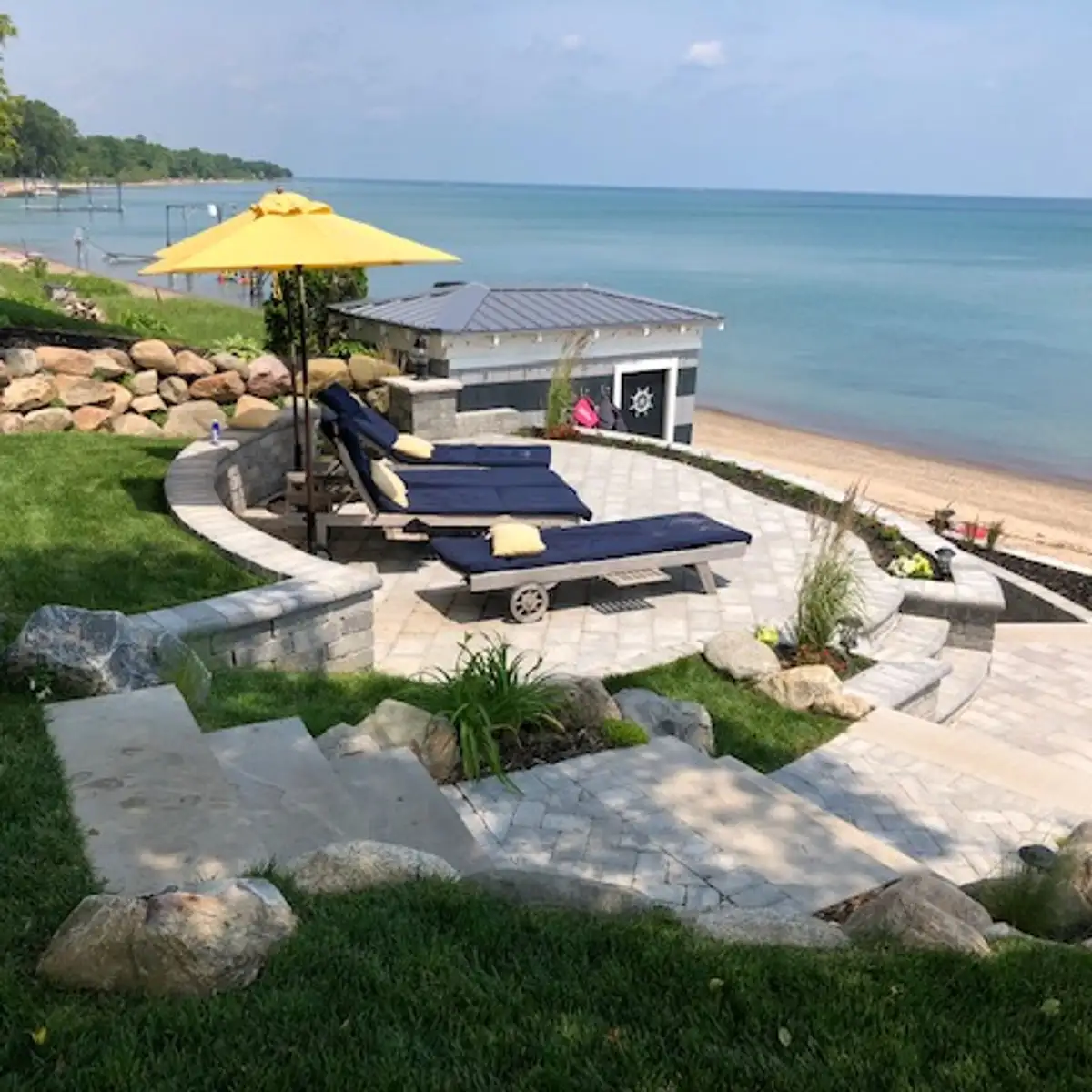
A fire pit extends your outdoor living season in Michigan by two full months. Most Oakland County homeowners stop using their backyards in mid-September and do not start again until late May. A well-built fire pit pushes that window from early April through mid-November, adding roughly 60 usable evenings to your year. This guide covers everything you need to plan a fire pit installation that performs through Michigan's freeze-thaw cycles and looks like it belongs in your landscape for decades.
Gas vs Wood-Burning: Which Is Right for You?
This is the first decision, and it affects everything that follows: budget, construction method, maintenance requirements, and how you actually use the fire pit. Both options work well in Oakland County. The right choice depends on how you plan to use the space.
Wood-Burning Fire Pits
A wood-burning fire pit is the simpler build and produces significantly more heat than gas. On a 40-degree October evening in Rochester Hills or Troy, the radiant heat from a wood fire warms everyone within 8 to 10 feet of the pit. Gas produces less than half that thermal output. If extending your outdoor season through the cold shoulder months is the primary goal, wood-burning delivers more warmth per dollar.
Wood also provides the traditional fire experience that many homeowners want: the crackle, the shifting flames, the smell of burning oak or cherry. For families with children, the ritual of building and tending a fire is part of the appeal.
The tradeoffs are maintenance and smoke. You need a place to store firewood (at least 20 feet from the house per fire code), you need to clean ash after every use, and smoke drifts with the wind. In denser neighborhoods across Bloomfield Township, Birmingham, and Ferndale, smoke can become a neighbor relations issue. Oakland County townships do not prohibit recreational wood fires, but some HOAs restrict them.
Gas Fire Pits
Gas fire pits ignite instantly with a switch or remote control, produce no smoke, require no ash cleanup, and maintain a consistent flame height for as long as you want them running. For homeowners who want a fire feature they will actually use three or four evenings a week rather than once a month, gas removes every barrier to spontaneous use.
Natural gas is the preferred fuel for permanent installations because the supply is unlimited and the operating cost is negligible. Most Oakland County properties have natural gas service. Propane is an option for properties without natural gas access, though it requires a buried tank or regular tank exchanges.
Gas fire pits cost more to install than wood-burning because they require a gas line run from the house, a licensed plumber for the connection, and a permit for the gas work. The fire pit itself also needs a purpose-built burner assembly, ignition system, and fire glass or lava rock media. Budget $3,000 to $8,000 more for gas than an equivalent wood-burning pit.
Material Choices for Michigan's Climate
The material you choose for the fire pit surround and seating walls needs to handle Michigan's freeze-thaw cycle, which can run 40 to 60 cycles per winter in Oakland County. Not every material performs equally under these conditions.
Techo-Bloc Products
As a Techo-Pro certified installer since 2018, we have built hundreds of fire pit surrounds and seating walls with Techo-Bloc products across Oakland County. Their concrete paver and wall systems are engineered for freeze-thaw performance with a minimum compressive strength of 8,000 PSI and water absorption rates below 5 percent. The Raffinato Wall system creates clean, modern fire pit surrounds, while the Mini-Creta wall offers a more natural stacked-stone aesthetic. Both systems handle Michigan winters without the spalling, cracking, or efflorescence that plague lesser products.
Natural Stone
Granite, basalt, and dense limestone are the natural stone options that perform best around fire pits in Michigan. These stones handle both the heat from the fire and the freeze-thaw cycle without cracking. Sandstone and softer limestones absorb moisture and can spall when that moisture freezes. We recommend natural stone for homeowners who want a one-of-a-kind look, and Techo-Bloc for homeowners who prioritize consistency, warranty coverage, and faster installation.
The Fire Pit Interior
Regardless of the exterior material, the interior of a fire pit needs a steel fire ring insert (for wood-burning) or a stainless steel burner pan (for gas). Direct contact between fire and masonry materials causes thermal stress cracking over time. A properly sized fire ring or burner pan contains the heat and protects the surround material. For wood-burning pits, use a ring at least 2 inches shorter than the interior diameter of the pit to allow air circulation beneath the fire.
Sizing and Placement
How Big Should a Fire Pit Be?
The interior diameter of the fire pit determines how many people can gather around it comfortably. A 36-inch interior fits 4 to 6 people. A 42-inch interior fits 6 to 8 people. A 48-inch interior accommodates 8 to 10. Most Oakland County residential fire pits land in the 36 to 42 inch range, which suits family use and small gatherings without dominating the patio space.
The overall footprint including the surround wall is typically 18 to 24 inches larger than the interior diameter. A 42-inch interior fire pit with a standard wall width occupies a circle roughly 6 feet across, and you need at least 5 feet of clear space around that for seating and foot traffic. That means a fire pit with seating requires a minimum area of about 16 feet by 16 feet.
Where to Place It
Fire safety codes in most Oakland County townships require a minimum of 10 feet between an open fire and any structure, including the house, garage, fence, pergola, or overhanging tree branches. Gas fire pits with approved enclosures may be permitted closer to structures, but check your township's specific requirements.
Beyond code requirements, consider wind patterns. Place the fire pit where prevailing winds (typically from the west and southwest in Oakland County) will carry smoke away from the house and primary seating area. If your property is on an exposed lot in Novi, Commerce Township, or Highland Township where wind is a regular factor, a partial windbreak wall on the west side of the pit improves usability significantly.
Proximity to your outdoor living space matters too. A fire pit that requires a 100-foot walk from the patio gets used far less than one integrated into or adjacent to the primary outdoor room. The best fire pit placements create a natural flow from the kitchen, dining, or lounging area to the fire.
Building the Fire Pit: The Right Way
Base and Base
Every permanent fire pit needs a stable base. In Oakland County's clay soils, that means excavating 8 to 12 inches below grade, installing 6 to 8 inches of compacted aggregate base, and capping with a level pad of compacted stone dust. This base prevents the fire pit from settling unevenly as the clay shifts through freeze-thaw cycles.
If the fire pit is being built as part of a larger patio installation, the patio base serves as the fire pit base and only the interior needs additional preparation. This is one of many reasons to plan the fire pit at the same time as the patio rather than adding it later.
Drainage
A fire pit collects rainwater. Without drainage, that water sits in the bottom, rusts metal components, and creates a muddy mess that takes a day or more to dry out after every rain. For wood-burning pits, install a drain at the lowest point of the pit floor, connected to a gravel drain field below grade. For gas pits, the burner pan should have weep holes and the base should slope slightly to one side where a drain line carries water away from the burner assembly.
Seating Integration
Built-in seating walls around a fire pit are one of the highest-value additions to any outdoor living space. A 12 to 18 inch tall seating wall with a smooth cap creates permanent, comfortable seating for 6 to 10 people without dragging chairs across the patio. The wall also defines the fire pit area as a distinct room within the larger outdoor space.
Match the seating wall material to the fire pit surround and the patio surface for a cohesive look. A Techo-Bloc seating wall with matching cap stones, surrounding a fire pit built from the same product line, on a paver patio from the same collection creates the kind of intentional, unified design that looks like it was always meant to be there.
Permits and Regulations in Oakland County
Most Oakland County townships do not require a building permit for a ground-level fire pit under 3 feet in diameter. However, the specifics vary by municipality:
- Gas fire pits: Require a plumbing permit for the gas line in all townships. Must be installed by a licensed plumber or gas fitter.
- Fire pits within covered structures: May require a building permit and must meet specific clearance requirements.
- Setback requirements: Typically 10 to 25 feet from structures depending on the township. Troy, Rochester Hills, Bloomfield Township, and West Bloomfield each have their own distance requirements.
- HOA restrictions: Many Oakland County subdivisions have covenant restrictions on fire pits. Check your HOA guidelines before planning.
- Burn bans: During dry periods, Michigan DNR may issue burn bans that prohibit open wood fires. Gas fire pits are typically exempt from burn bans.
We handle permit coordination for every fire pit project, ensuring the installation meets all local requirements before construction begins.
What Does a Fire Pit Cost in Oakland County?
Fire pit costs in Oakland County depend on materials, fuel type, and the scope of surrounding hardscape work:
- Basic built-in fire pit (stone or block surround, wood-burning, on existing patio): $2,500 to $5,000
- Mid-range fire pit with seating walls (Techo-Bloc or natural stone, integrated with patio, wood or gas): $6,000 to $15,000
- Premium fire feature (custom stonework, gas ignition, built-in seating, landscape lighting integration, full outdoor living room): $15,000 to $30,000+
Gas adds $3,000 to $8,000 to any configuration due to the gas line, burner assembly, and permit costs. However, gas eliminates all ongoing firewood costs ($200 to $400 per year for regular use) and maintenance time.
Frequently Asked Questions
Do I need a permit for a fire pit in Oakland County?
Most townships do not require a building permit for a ground-level fire pit under 3 feet in diameter. Gas fire pits with permanent gas lines require a plumbing permit. Any fire pit within a covered structure may require a building permit. Check with your specific township, as Troy, Rochester Hills, Bloomfield Township, and West Bloomfield each have their own regulations. HOA restrictions may also apply.
How much does a fire pit cost to install in Michigan?
A basic built-in fire pit costs $2,500 to $5,000 installed. Mid-range fire pits with seating walls and patio integration run $6,000 to $15,000. Premium fire features with custom stonework, gas ignition, and full outdoor living integration range from $15,000 to $30,000 or more.
Should I choose a gas or wood-burning fire pit?
Gas fire pits offer instant ignition, no smoke, no ash cleanup, and consistent flame height. Wood-burning fire pits cost less to build, produce more heat, and provide the traditional campfire experience. Gas is better for frequent, casual use and smoke-sensitive neighbors. Wood is better for maximum warmth during Michigan's cool evenings and traditional fire gatherings.
Build Your Fire Pit This Spring
May and June are the ideal months to start a fire pit project in Oakland County. The ground is workable, the construction schedule is open, and you will have the fire pit ready for use through the entire summer, fall, and into early winter. Earth Art Landscaping has been designing and building outdoor living spaces across Oakland County since 1987. Every fire pit we build is engineered for Michigan's climate and designed to integrate seamlessly with the surrounding landscape.
Call 810-343-4799 or request a free quote online to schedule your fire pit consultation.